

Children do not start life with emotional control, empathy, or communication skills. These abilities develop gradually—but only after something more fundamental is established: emotional safety.
Before a child can manage emotions, they must first feel safe experiencing them. This concept—often described as emotional safety first—is central to early childhood development. Without a strong sense of felt security, emotional skills remain fragile, inconsistent, or delayed.
In high-quality early learning environments, emotional safety is not treated as an optional feature. It is the foundation upon which all learning, behavior, and relationships are built.
What Is Emotional Safety in Early Childhood?
Emotional safety is a child’s internal sense of being secure, accepted, and supported. It goes beyond physical protection and includes:
- Feeling understood by caregivers
- Trusting that needs will be met
- Experiencing calm and predictability
- Knowing that emotions are allowed
Importantly, emotional safety is not taught through instruction—it is built through repeated experiences.
When children consistently experience responsive care, their brains begin to recognize the environment as safe. Over time, this becomes internalized as felt security.
Why Emotional Safety Comes Before Emotional Skills
Emotional skills—such as self-regulation, empathy, and problem-solving—require a stable internal state.
When a child feels unsafe:
- The brain activates stress responses (fight, flight, or freeze)
- Emotional reactions become intense and reactive
- Learning capacity decreases
When a child feels safe:
- The brain remains regulated
- Emotional processing becomes possible
- Social engagement increases
This is why emotional safety is described as a foundation before skills. Without it, teaching emotional regulation is ineffective.
The Neuroscience of Felt Security
From a neuroscience perspective, early experiences directly shape brain development.
Key processes include:
- Stress regulation: Safe environments reduce cortisol levels
- Neural pathway formation: Repeated safe interactions strengthen emotional control systems
- Prefrontal cortex development: Supports decision-making and self-regulation
When caregivers respond consistently and calmly, children’s nervous systems learn to return to a balanced state more quickly.
Over time, this creates resilience.
In contrast, inconsistent or unpredictable care can keep the child’s brain in a heightened state of alertness, making emotional development more difficult.
Signs a Child Feels Emotionally Safe (or Not)
Understanding whether a child feels safe is essential for caregivers.
Signs of Emotional Safety
- Seeks comfort from caregivers
- Engages in play and exploration
- Recovers from distress with support
- Shows curiosity and social interest
Signs Emotional Safety May Be Lacking
- Avoids interaction or connection
- Displays frequent emotional outbursts
- Has difficulty calming down
- Shows withdrawal or anxiety
These behaviors are not simply “good” or “bad”—they reflect the child’s internal sense of safety.
How Children Experience Emotional Safety in Group Care
Consistent Caregiving
Consistency is one of the strongest predictors of emotional safety. When caregivers respond in predictable ways, children learn what to expect.
This includes:
- Calm responses to distress
- Reliable routines
- Stable caregiver presence
Predictable Environments
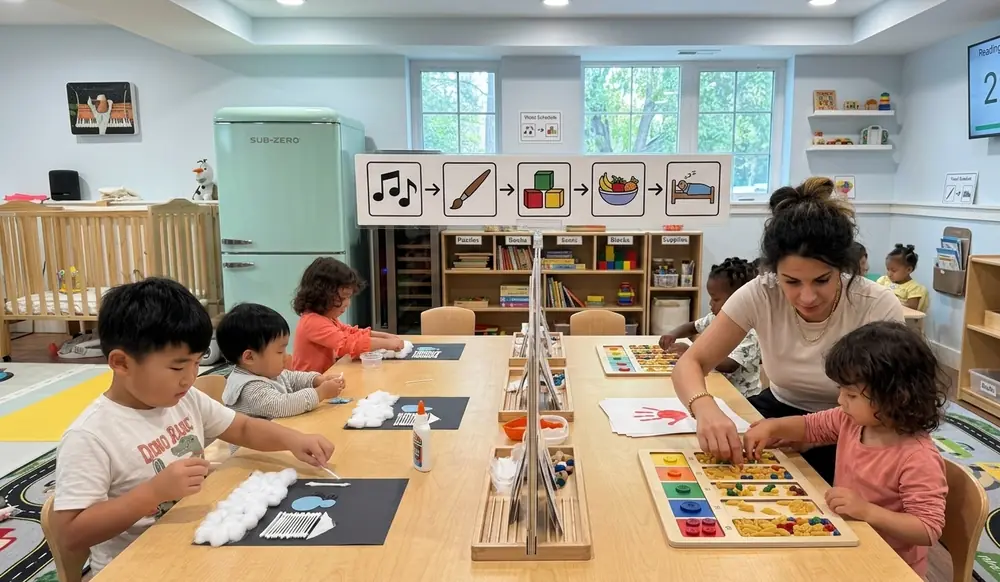
Structured environments reduce uncertainty. Daily routines—such as meals, playtime, and rest—create a rhythm that children can rely on.
This predictability supports emotional stability.
Emotional Responsiveness
Children feel safe when their emotions are acknowledged, not dismissed.
Examples include:
- Naming emotions (“You’re feeling upset”)
- Offering comfort
- Staying present during distress
These interactions build trust over time.
Co-Regulation: The Bridge to Self-Regulation
Children do not develop self-regulation on their own. First, they rely on adults through co-regulation.
Co-regulation involves:
- A caregiver helping a child calm down
- Modeling emotional responses
- Providing guidance during difficult moments
For example:
A child becomes frustrated during play. Instead of expecting them to calm down independently, the caregiver sits nearby, speaks calmly, and helps the child process the situation.
Repeated experiences like this gradually build the child’s ability to self-regulate.
Real-Life Scenarios in Daycare Settings
Scenario 1: Separation Anxiety
A child cries when a parent leaves.
A responsive caregiver:
- Acknowledges the feeling
- Offers reassurance
- Maintains a calm presence
Over time, the child learns that separation is temporary and manageable.
Scenario 2: Conflict Between Children
Two children argue over a toy.
Instead of punishment, the caregiver:
- Guides both children through the conflict
- Validates emotions
- Encourages problem-solving
This supports both emotional safety and skill development.
Scenario 3: Overstimulation
A child becomes overwhelmed in a busy classroom.
A supportive environment provides:
- A quiet space
- Reduced stimulation
- Gentle guidance
This helps the child regain emotional balance.
What Happens When Emotional Safety Is Missing
Without emotional safety:
- Stress responses remain activated
- Emotional regulation becomes difficult
- Social interactions may suffer
Children may develop coping behaviors such as:
- Withdrawal
- Aggression
- Avoidance
These are not behavioral problems—they are adaptive responses to perceived insecurity.
Building Emotional Safety in Daycare Environments
Daily Routines and Structure
Clear routines create predictability. Children feel more secure when they understand what comes next.
Caregiver-Child Relationships
Strong relationships are essential. Caregivers should focus on:
- Trust-building
- Emotional availability
- Consistency
Environment Design
The physical space should:
- Minimize overstimulation
- Include calming areas
- Support independent exploration
WAC Washington State Standards and Emotional Safety
Childcare programs that follow Washington Administrative Code (WAC) guidelines emphasize:
- Safe and nurturing environments
- Developmentally appropriate interactions
- Emotional well-being as a core priority
- Responsive caregiving practices
These standards align closely with research on emotional safety, reinforcing its importance in licensed childcare settings.
Long-Term Impact on Development
Children who experience emotional safety early are more likely to:
- Develop strong emotional regulation
- Build healthy relationships
- Show resilience under stress
- Demonstrate confidence and independence
These outcomes extend into adolescence and adulthood.
Practical Strategies for Caregivers and Parents
To support emotional safety:
- Maintain consistent daily routines
- Respond calmly to emotional reactions
- Validate children’s feelings
- Build strong, trusting relationships
- Provide predictable environments
Consistency—not perfection—is what matters most.
Conclusion
Emotional safety is not something that can be replaced by instruction or rushed through teaching. It is built slowly, through consistent care, predictable environments, and meaningful relationships.
Before children can regulate emotions or build social skills, they must first feel secure. This sense of felt security becomes the foundation for every aspect of emotional development.
When early learning environments prioritize emotional safety, they are not just supporting children in the present—they are shaping their future ability to learn, connect, and thrive.
About Kido Heaven Early Learning Center
At Kido Heaven Early Learning Center, we believe that emotional development begins with safety. Our programs are designed to provide structured, nurturing environments where children feel secure, supported, and understood.
Through consistent caregiving, thoughtful routines, and responsive interactions, we help children build the strong emotional foundation they need for lifelong success.
If you are searching for trusted Daycare Bothell or reliable child care Bothell, our approach ensures that emotional safety always comes first.
Why KidoHeaven Stands Out
✅ Licensed in Washington State
✅ Aligned with Early Achievers standards
✅ Working Connections subsidy accepted
✅ Daily updates via Brightwheel
✅ Located in Bothell, serving Mill Creek, Lynnwood & nearby areas
✅ Nutritious snacks, safe outdoor space, & positive mealtime routines
📞 Call 206-734-2040 to schedule a tour
🌐 Enroll now
Follow Our Mealtime Moments
Stay updated with more beautiful outdoor meals and daily learning routines on:
Instagram | Facebook | Nextdoor | Yelp | Winnie | YouTube | Upwards
FAQ
1. Why is emotional safety more important than emotional skills?
Because without safety, the brain cannot effectively learn or apply emotional skills.
2. How can daycare support emotional safety?
Through consistent caregiving, structured routines, and responsive interactions.
3. What is felt security?
It is the internal sense of safety a child develops through repeated supportive experiences.
4. Can emotional safety improve over time?
Yes. With consistent care and supportive environments, children can develop a stronger sense of safety.
5. What role do caregivers play?
Caregivers are central—they provide the relationships and experiences that build emotional safety.
Visit Kido Heaven Child Care
A licensed home daycare for infants to pre-K, serving Bothell and Mill Creek. Call or text (206) 734-2040 or book a tour.
Book a Tour